
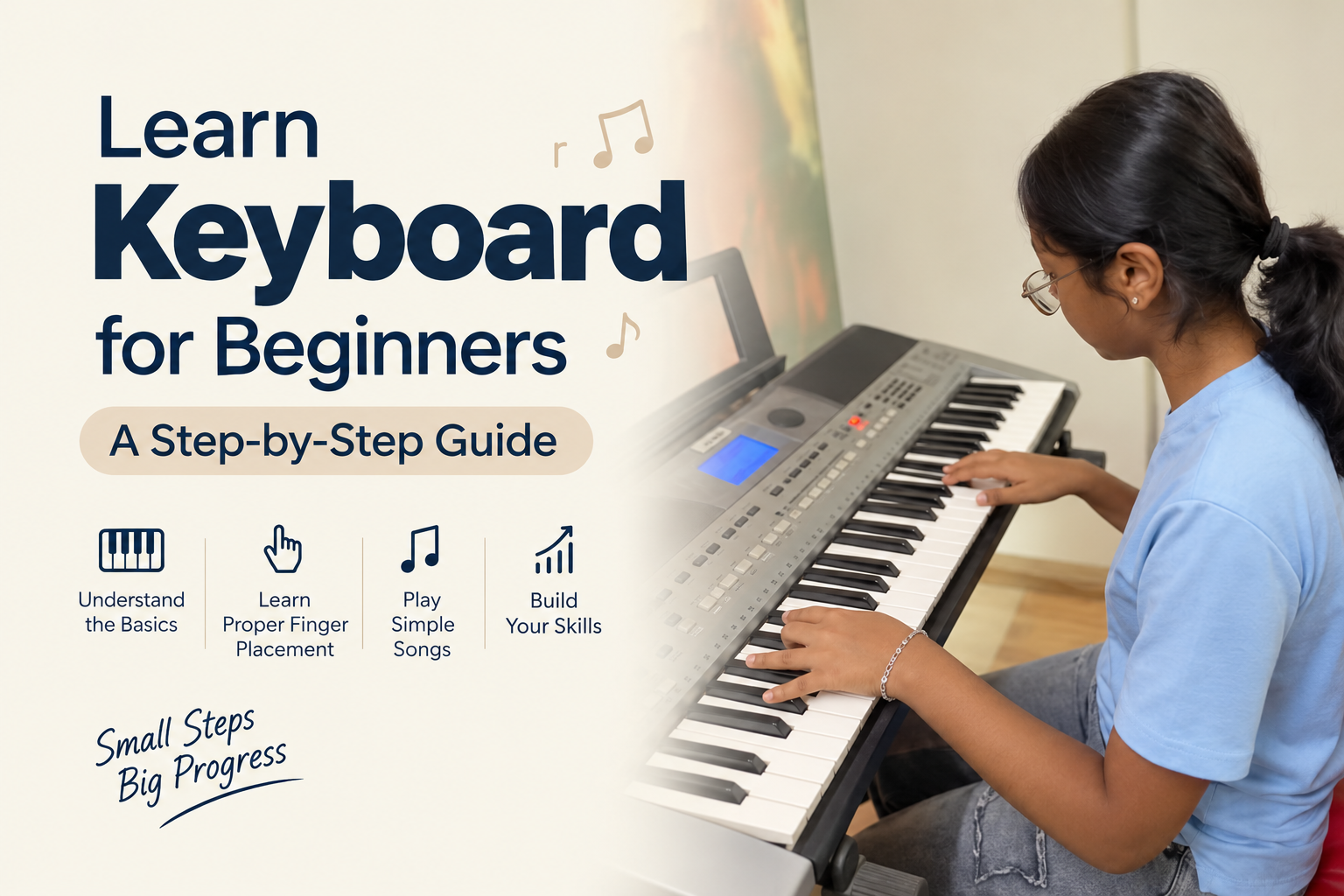
To learn keyboard for beginners, start with a 61-key, touch-sensitive keyboard. First, learn the note names C to B and find middle C. Next, learn your finger numbers 1 to 5 and practise the C major scale with the correct fingering. Then play simple right-hand melodies and add easy left-hand chords like C, F and G. Just 15–20 minutes of daily practice builds steady progress.
This guide breaks the journey into seven clear steps, so you always know what to practise next. At Aarambh Music & Dance Academy in Rohini Sector 8, our keyboard classes in Rohini follow this same path for children, teenagers and adults.
Is Keyboard Easy to Learn for Beginners?
Yes. The keyboard is one of the easiest instruments to start with, because every note sits in a clear, visible row. You press a key and it plays the right note, so there is no tuning and no sore fingertips. As a result, most beginners play a simple tune within their first few weeks.
The keyboard also teaches music theory in a very visual way. For that reason, many teachers recommend it as a first instrument. Still unsure? Compare your options in our guide to the best musical instrument for beginners: guitar, keyboard or drums.
How to Learn Keyboard for Beginners: 7 Steps
Step 1: Choose the right keyboard
For most beginners, a 61-key keyboard is enough. Look for touch-sensitive (or velocity-sensitive) keys, which play louder when you press harder. This helps you learn to play with feeling. Also, check that it has a headphone socket and a stand, so you can sit at the right height.
| Keyboard type | Keys | Best for |
| Portable keyboard | 61 | Beginners, kids, songs and basic theory |
| Larger keyboard | 76 | Students who want more range for two-hand pieces |
| Digital piano | 88 (weighted) | Students planning piano exams or classical pieces |
Which keyboard should a beginner choose?
Step 2: Sit with the right posture
Sit near the middle of the keyboard, with your feet flat on the floor. Keep your back straight and your shoulders relaxed. Your forearms should be level with the keys. Finally, curve your fingers gently, as if you are holding a small ball.
Step 3: Learn the note names and find middle C
Music uses only seven letter names: C, D, E, F, G, A and B. After B, the pattern starts again with C. The white keys play these notes, while the black keys play the sharps and flats in between.
Here is an easy trick. Look at the black keys and notice they sit in groups of two and three. The white key just to the left of any group of two black keys is always C. The C closest to the centre of your keyboard is called middle C, and it is your home base.
Step 4: Learn your finger numbers
Keyboard music uses numbers to tell you which finger to use. On both hands, the thumb is 1, the index finger is 2, the middle finger is 3, the ring finger is 4 and the little finger is 5. Once you know these, you can follow the fingering printed in any beginner book.
Step 5: Play the C major scale
The C major scale uses only white keys, so it is the perfect first scale. It goes C D E F G A B C. However, you only have five fingers, so you need a smooth “thumb-under” move in the middle.
| Note | C | D | E | F | G | A | B | C |
| Right hand (going up) | 1 | 2 | 3 | 1 | 2 | 3 | 4 | 5 |
| Left hand (going up) | 5 | 4 | 3 | 2 | 1 | 3 | 2 | 1 |
C major scale fingering for one octave. The right thumb passes under after E; the left hand’s 3rd finger crosses over after G.
Play it slowly with one hand at a time. Keep every note even in volume and length. Then, when it feels smooth, try it with a metronome at a slow speed.
Step 6: Learn rhythm and your first three chords
Rhythm tells you how long to hold each note. In most beginner music, a whole note lasts 4 beats, a half note lasts 2 beats and a quarter note lasts 1 beat. Count out loud as you play.
Next, learn three simple chords with your left hand. A chord is three or more notes played together. With just these three, you can play along to hundreds of simple songs.
| Chord | Notes | Left-hand fingers |
| C major | C – E – G | 5 – 3 – 1 |
| F major | F – A – C | 5 – 3 – 1 |
| G major | G – B – D | 5 – 3 – 1 |
The first three chords to learn on keyboard.
Step 7: Play your first songs with both hands
Now put it all together. Play the melody with your right hand and hold one chord with your left hand on the first beat of each bar. Start with slow, familiar tunes such as “Twinkle Twinkle Little Star”, “Happy Birthday” or “Jingle Bells”. After that, try a simple Bollywood melody your teacher sets for you.
Your First 8 Weeks on Keyboard
Every student learns at their own pace. However, this plan shows what most beginners can achieve with 15–20 minutes of practice a day.
| Weeks | What you learn | Practice goal |
| 1–2 | Posture, note names, middle C, finger numbers | Name any white key in 2 seconds |
| 3–4 | Five-finger melodies in the right hand, whole, half and quarter notes | Play one simple tune without stopping |
| 5–6 | C major scale in each hand, C, F and G chords | Change between chords in time |
| 7–8 | Melody plus left-hand chords together | Play your first two-hand song |
A realistic 8-week plan to learn keyboard for beginners.
6 Common Mistakes Keyboard Beginners Make
- Flat fingers. Keep them curved so each finger presses cleanly.
- Looking down all the time. Learn the key pattern so your eyes can stay on the music.
- Ignoring fingering. The right finger numbers make fast passages easy later.
- Skipping the left hand. Practise it alone, just as much as the right.
- Using only auto-accompaniment. Built-in rhythms are fun, but first learn to keep time yourself.
- Practising only once a week. Short daily practice works far better than one long session.
How Long Does It Take to Learn Keyboard?
Most beginners play simple songs with both hands within 2–3 months of regular practice. Reading music comfortably and playing songs you choose usually takes 6 months to a year. Becoming an advanced player takes a few years of steady training.
Graded exams give you a clear goal each year. For example, Trinity College London runs graded Electronic Keyboard exams from Initial level to Grade 8, and Rockschool (RSL) offers graded Keys exams. At Aarambh, we prepare keyboard students for Trinity and Rockschool exams.
Why Learn Keyboard With a Teacher?
Apps and videos are useful for practice. However, a teacher spots problems you cannot see yourself, such as tense wrists, wrong fingering or uneven rhythm. Fixing these early saves months of unlearning later. Learning music also has real benefits for children’s growing brains, as we explain in why learning music at a young age boosts brain development.
Learn Keyboard for Beginners at Aarambh Academy, Rohini
Aarambh Music & Dance Academy teaches keyboard to beginners and advanced students in small groups, so every student gets personal attention. Our classes cover:
- Correct posture and hand position
- The musical alphabet and reading notation
- Whole, half and quarter notes
- The C major scale and chords such as C and F
- Playing from sheet music
- Using the keyboard’s different sounds and settings
- Preparation for Trinity College London and Rockschool exams
- Stage practice at our annual show, Swaranjali
| Levels | Beginner to advanced, grouped by age and skill |
| Age | From around 5 years, no upper age limit |
| Exams | Trinity College London and Rockschool |
| Address | F19/5, 2nd Floor, Rohini Sector 8, near Deepali Chowk, Delhi-110085 |
| Phone | +91-98111 40614 |
Keyboard classes at Aarambh Music & Dance Academy, Rohini.
Want to try a class first? Book a free demo class and our team will call you within 24 hours, or visit our admissions page to enrol.
Frequently Asked Questions
Can I learn keyboard without reading music?
Yes, you can start by learning note names and playing by ear or from letter notes. However, learning to read music early makes it much easier to learn new songs and take exams later.
What age can a child start keyboard?
Children can usually start keyboard at around 5 years old, once they can sit and focus for 20–30 minutes. Adults can start at any age.
Should a beginner buy 61 or 76 keys?
A 61-key touch-sensitive keyboard is enough for most beginners. Choose 76 or 88 keys if you plan to play larger two-hand pieces or take piano exams.
Is keyboard easier than guitar?
For most beginners, yes. Keyboard notes are laid out in a clear line and need no finger strength to press, so early progress feels quicker. Guitar builds finger strength and is easier to carry around.
How long should I practise keyboard every day?
Beginners should practise for 15–20 minutes a day, 5–6 days a week. Short, focused practice builds skill faster than one long session. Parents can find more tips in our guide for parents on learning a musical instrument.
Start Playing Today
To learn keyboard for beginners, take it one step at a time: find middle C, learn your finger numbers, master the C major scale, then add simple chords. With steady daily practice, you will play your first two-hand song within two months. Ready to begin? Book your free keyboard demo class at Aarambh Academy, Rohini Sector 8.