
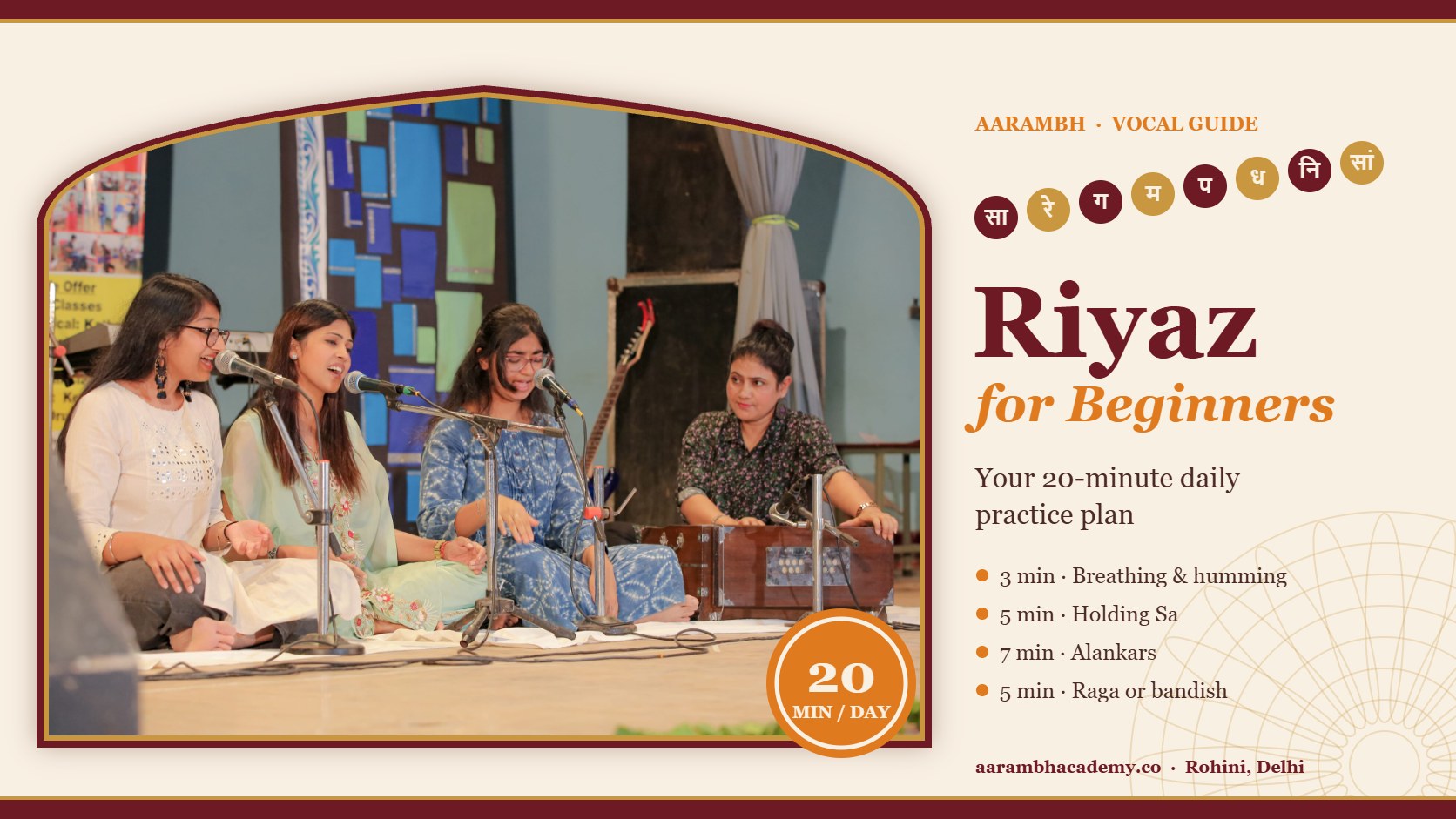
Good riyaz for beginners takes about 20 minutes a day. Spend 3 minutes on breathing and humming, 5 minutes holding a steady Sa with a tanpura, 7 minutes on alankars at a slow, even tempo, and 5 minutes on one raga’s aaroh-avroh or a simple bandish. Practise at the same time every day, and record yourself once a week.
Many students practise for two hours one day, then nothing for a week. However, steady daily practice builds a voice far faster. This guide gives you a plan you can actually keep. It is the same routine we give new students in our Indian classical vocal classes in Rohini.
What Is Riyaz?
Riyaz means disciplined, repeated practice in Indian classical music. It is not the same as simply singing songs. Instead, you work on one small thing at a time: your breath, your pitch, your note patterns and your raga.
In the guru-shishya tradition, riyaz is the student’s daily duty between classes. Your guru shows you what to practise; riyaz is where the voice actually changes. For the bigger picture of classical training, see our complete guide to learning Indian classical singing.
Watch our Hindustani vocal students at Aarambh Academy, Rohini:
The 20-Minute Riyaz Plan for Beginners, Step by Step
Here is the full riyaz for beginners routine. Sit cross-legged or on a chair with a straight back, switch on a tanpura or tanpura app, and begin.
| Minutes | What you practise | Why it matters |
| 0–3 | Deep breathing and gentle humming | Warms the voice and steadies the breath |
| 3–8 | Hold a steady Sa with the tanpura | Trains pitch and builds a strong base note |
| 8–15 | Alankars, slowly and evenly | Builds flexibility, accuracy and stamina |
| 15–20 | One raga’s aaroh-avroh, or a simple bandish | Turns exercises into real music |
A 20-minute riyaz plan for beginners.
Minutes 0–3: Breathing and humming
Breathe in slowly through the nose for 4 counts, hold for 2, then breathe out for 6. Repeat this five times. After that, hum softly on a comfortable note with your lips closed and jaw relaxed. Your lips should tingle slightly.
Minutes 3–8: Holding Sa (kharaj practice)
Sa is your home note, and everything else is measured from it. Sing one long Sa on “aa”, matching the tanpura exactly. Hold it for as long as your breath allows without pushing, then rest and repeat.
Many teachers also give kharaj practice, which means singing in the lower octave. This opens the voice and makes the tone richer. Keep it soft and never force the low notes.
Minutes 8–15: Alankars
Alankars are note patterns sung up and down the scale. They are the scales and exercises of Indian classical singing. Start with these two, going up (aaroh) and then back down (avroh):
- Alankar 1: Sa Re Ga Ma, Re Ga Ma Pa, Ga Ma Pa Dha, Ma Pa Dha Ni, Pa Dha Ni Sa’
- Alankar 2: Sa Re Ga, Re Ga Ma, Ga Ma Pa, Ma Pa Dha, Pa Dha Ni, Dha Ni Sa’
Sing them slowly at first, giving every note the same length and volume. Speed is not the goal; accuracy is. Once a pattern feels easy, your guru will add a faster one.
Minutes 15–20: Your raga or bandish
Finish with music, not exercises. Sing the aaroh and avroh of the raga your guru has given you, then a short aalap. If you have learnt a bandish, sing it slowly and clearly. This is where the day’s practice starts to sound like a performance.
Watch Shashank, an Aarambh student, sing Raag Darbari at Swaranjali 2026:
When Is the Best Time for Riyaz?
Early morning is the traditional time for riyaz for beginners, because the mind is fresh and the surroundings are quiet. However, the best time is the one you can keep every day. An evening routine done daily beats a morning routine done twice a week.
Listen to Raag Bhairavi, a raga traditionally sung in the morning:
Avoid singing straight after a heavy meal. Wait about an hour, and sip water through your session. Students balancing school or college can also take ideas from our guide on balancing school and practice.
What Do You Need for Riyaz for Beginners at Home?
- A tanpura or tanpura app, set to your scale. Your guru will tell you which scale suits your voice.
- A quiet corner where you will not be disturbed for 20 minutes.
- A bottle of water at room temperature.
- A notebook for the alankars and bandish your guru gives you.
- Your phone’s voice recorder, to record yourself once a week.
A harmonium is useful, but it is not essential at the start. At Aarambh, students learn with both tanpura and harmonium in class.
How to Track Your Progress
Progress from riyaz for beginners is slow and easy to miss. Therefore, record yourself singing the same alankar on the first day of every month. After three months, listen to the recordings one after the other. You will clearly hear steadier pitch and longer breath.
Also, tick off each day’s riyaz in your notebook. Aim for five or six days a week, not seven. One rest day protects your voice.
6 Riyaz Mistakes Beginners Should Avoid
- Singing without a tanpura. Without a reference drone, pitch drifts and you do not notice.
- Starting loud and high. Always warm up first in your comfortable middle range.
- Practising too fast. Slow, clean notes build control; fast, sloppy ones build bad habits.
- Skipping alankars. They feel boring, yet they are what actually trains the voice.
- Forcing high or low notes. If your throat hurts, stop. Range grows slowly and safely.
- Singing only songs. Film songs are fun, but they are not riyaz.
Riyaz and Voice Care
Your voice is a part of your body, so treat it kindly. Drink water through the day, avoid shouting, and rest your voice when it feels tired. Delhi’s dusty air and winter weather can also make the throat dry, so a steady habit of hydration helps.
Skip riyaz on days when your throat is sore, and never push through pain. According to the US National Institute on Deafness and Other Communication Disorders, hoarseness that lasts more than two weeks should be checked by a doctor.
How Long Before Riyaz Shows Results?
Most beginners notice steadier pitch and better breath control within 4–6 weeks of daily riyaz. Clear raga singing usually takes several months, and a full bandish with improvisation takes longer still. The voice improves quietly, and then one day you hear the difference.
| Time | What usually improves |
| Weeks 1–2 | The habit itself: sitting down daily and warming up properly |
| Weeks 3–6 | Steadier Sa, longer breath, fewer wobbles between notes |
| Months 2–4 | Cleaner alankars at a faster tempo, better sense of the raga |
| Months 5–12 | Singing a bandish confidently and a short aalap of your own |
What to expect from daily riyaz for beginners.
Riyaz for Beginners at Aarambh Academy, Rohini
Riyaz works best when a guru checks your practice regularly. Otherwise, small errors in pitch or breath quietly become habits. At Aarambh Music & Dance Academy, our Indian classical vocal classes cover:
- Strong basics: swar, alankar, voice culture and breath control
- Hindustani classical styles including Dhrupad, Khyal and Tarana
- Light classical forms such as thumri, dadra, ghazal and bhajan
- Practice with tanpura and harmonium
- Separate groups by level, with small batches
- Preparation for practical and theory exams through Prayag Sangeet Samiti
- Stage practice at our annual show, Swaranjali
| Levels | Beginner to advanced, in small batches grouped by level |
| Age | From around 5 years, no upper age limit |
| Address | F19/5, 2nd Floor, Rohini Sector 8, near Deepali Chowk, Delhi-110085 |
| Phone | +91-98111 40614 |
Indian classical vocal classes at Aarambh Music & Dance Academy, Rohini.
Watch an Indian classical vocal performance by our Vocal Guru at Aarambh Music & Dance Academy:
Want your riyaz checked by a teacher? Book a free demo class and our team will call you within 24 hours, or visit our admissions page to enrol.
Frequently Asked Questions
Can I do riyaz without a tanpura?
You can, but it is much harder to stay in tune. A free tanpura app on your phone works well and costs nothing, so there is no real reason to practise without one.
How long should a beginner’s riyaz be?
Twenty minutes a day is enough for a beginner. As your stamina grows, your guru may extend it to 45 minutes or an hour. Daily practice matters far more than long practice.
Should I do riyaz when I have a cold?
No. Rest your voice instead, and do only gentle breathing exercises. Singing through a sore throat can strain the vocal cords and delay recovery.
Is riyaz only for classical singers?
No. Playback, Bollywood, ghazal and devotional singers all use the same basics of pitch, breath and voice control. Classical riyaz simply builds the strongest foundation, whatever style you sing later. Our post on the benefits of Indian classical vocal music explains more.
What age can a child start riyaz?
Children can start from around 5 years with short, playful sessions of 5–10 minutes. Build up to 20 minutes slowly, and keep it enjoyable rather than strict.
Start Your Riyaz Today
Riyaz for beginners does not need hours of free time. It needs 20 honest minutes, a tanpura and a little patience. Start tomorrow morning: breathe, hold your Sa, sing your alankars and end with your raga. Ready for guidance? Book your free vocal demo class at Aarambh Academy, Rohini Sector 8.