Performing in front of an audience can feel completely different from practising in a dance class. You may know every step, remember the choreography and feel confident during rehearsals — but as soon as the stage lights come on, your heart starts beating faster and your mind suddenly goes blank.
This is commonly known as stage fear, or performance anxiety.
For dancers, stage fear can affect concentration, expressions, body movement, rhythm and overall confidence. The good news is that feeling nervous before a performance is completely normal. With regular practice, proper preparation and the right mindset, dancers can learn to manage those feelings and perform with far greater confidence.
This is especially true in classical forms such as Bharatanatyam and Kathak, where posture, rhythm and expression all have to work together at the same time. If that already feels demanding in class, the stage can feel like a lot. (Here’s why classical dance takes time to master.)
Whether you are preparing for your very first stage performance or you already perform regularly, understanding how to handle nervousness can make a real difference.
What Is Stage Fear in Dance?
Stage fear is the nervousness or anxiety a person experiences before or during a public performance. For dancers, it shows up in different ways. You might experience:
- A fast heartbeat
- Sweaty palms
- Shaking hands or legs
- Difficulty remembering choreography
- Tense or blank facial expressions
- Loss of concentration
- Fear of making mistakes
- Discomfort while performing in front of people
Some dancers feel completely confident in class but become nervous the moment they see a large audience. This does not mean you are a bad dancer. It simply means your body is reacting to an unfamiliar, high-pressure situation.
Why Do Dancers Feel Nervous Before Performing?
There is no single reason behind stage fear. Different dancers experience it for different reasons.
Fear of Making Mistakes
One of the biggest reasons dancers feel nervous is the fear of forgetting a step. You may think:
“What if I forget the choreography?” “What if I miss the beat?” “What if everyone notices my mistake?”
These thoughts can raise anxiety before the performance has even begun. The important thing to remember is that small mistakes are a normal part of performing. Even experienced performers make them. What matters is how calmly you recover and continue.
Fear of Being Judged
Dancers often worry about what the audience, teachers, friends or family will think. This makes you focus on other people’s reactions instead of your own performance.
Instead of asking “Are they judging me?”, shift your attention to:
- Am I enjoying this performance?
- Am I expressing the music?
- Am I connecting with the audience?
This simple change in mindset makes performing feel far more natural.
Lack of Stage Experience
A dancer who has never performed on stage will naturally feel nervous. The first performance feels intimidating because everything is different:
- The stage is larger than the classroom
- The lights are brighter
- The audience is watching
- The sound system feels unfamiliar
- There is backstage pressure and waiting
The more you perform, the more familiar all of this becomes. Stage confidence is built through experience, not overnight — which is also why choosing a form you genuinely enjoy matters. (Not sure where to start? Compare Kathak and Bharatanatyam for beginners.)
Exam and Competition Pressure
Stage fear is not limited to annual functions. A practical dance exam, a scholarship audition or an inter-school competition is also a performance in front of an audience — often with a theory component alongside it. Many students feel this pressure most sharply during exam season, and it is one of the most common reasons dancers ask for help with nerves.
How to Overcome Stage Fear in Dance Performances
The goal is not to eliminate nervousness completely. The goal is to manage it so that it does not control your performance. Here are twelve practical strategies.
1. Know Your Choreography Thoroughly
Confidence starts with preparation. If you are unsure about your choreography, you are far more likely to panic on stage. Instead of simply repeating the whole routine again and again, break it into smaller sections:
- Practise the opening section
- Practise the middle sequence
- Practise the transitions between sections
- Practise the ending
- Then run the complete choreography
Strong preparation removes uncertainty, and less uncertainty means less fear.
2. Practise Without the Mirror
Mirrors are useful in training — they let you check posture, expressions, hand positions and alignment. But dancers also need to practise without relying on them. Try performing your full routine looking forward instead of at your reflection. This helps you understand how the choreography feels when you cannot constantly check yourself, and it makes the jump from classroom to stage much smaller.
3. Practise in Front of Other People
If you always practise alone, performing in front of an audience feels like a completely new experience. Start small and build up. Perform your routine in front of:
- Parents
- Siblings
- Friends
- Classmates
- Your dance teacher
Gradually increase the size of your audience. This trains your brain to be comfortable being watched.
4. Record Your Performances
Recording yourself is one of the simplest ways to understand your own performance. Watch the recording carefully and observe your facial expressions, posture, hand movements, footwork, timing, eye focus and overall stage presence.
Don’t watch it only to hunt for mistakes. Notice what you are doing well too. That builds awareness without turning into self-criticism.
5. Use Breathing Exercises Before Going On Stage
Nervousness makes your breathing quick and shallow. A few slow breaths before performing can help you feel more settled. Try this:
- Take a slow breath in.
- Pause briefly.
- Breathe out slowly.
- Repeat four or five times.
Keep your attention on your breathing rather than on what might go wrong. The aim is to walk on stage focused rather than overwhelmed.
6. Avoid Last-Minute Overthinking
A common mistake is mentally running through the entire choreography over and over in the final minutes before performing. This usually increases anxiety rather than reducing it. Instead, remind yourself of just a few anchor points:
- Your starting position
- The first musical cue
- Your rhythm
- Natural expressions
- Enjoying the performance
You have already practised. Trust your preparation.
7. Focus on the Music, Not the Audience
When dancers keep looking at the audience and thinking about being judged, concentration slips. Connect with the music instead — the rhythm, the melody, the lyrics, the changes in tempo, the important musical cues. When you are genuinely connected to the music, your movements and expressions become far more natural.
8. Learn to Recover From Mistakes
One of the most valuable skills a dancer can build is continuing after a mistake. Suppose you forget one movement:
- Don’t stop.
- Don’t show panic on your face.
- Don’t look at your fellow dancers in alarm.
- Simply rejoin the choreography at the next familiar point.
Most of the audience will not even realise anything happened. A calm recovery always looks better than a dancer visibly worrying about an error.
9. Work on Facial Expressions
Stage fear tends to make the face look tense or blank. This matters enormously in classical dance, where expression and storytelling carry as much weight as technique. During practice, work deliberately on eye focus, facial expressions, your smile, emotional transitions and character portrayal.
The more comfortable you become expressing emotion while dancing, the stronger your stage presence becomes. (Read our full guide to improving dance expressions.)
10. Visualise Your Performance
Visualisation is a well-known preparation technique. Before the performance, close your eyes and picture yourself walking onto the stage, taking your position, hearing the music begin, performing the opening movement, completing the choreography confidently and receiving the applause at the end. This makes the situation feel familiar before you actually step onto the stage.
11. Arrive Early and Get Comfortable With the Stage
Arriving at the venue early removes a lot of unnecessary stress. If possible, familiarise yourself with the stage size, the entrance and exit points, the sound setup, the lighting, your position and the other performers. Knowing your surroundings makes the actual performance feel far less unfamiliar.
12. Don’t Compare Yourself With Other Dancers
Every dancer is at a different stage. One performer may have trained for years; another may be performing for the very first time. Comparing yourself in the wings, minutes before you go on, only damages your confidence. Focus on your own preparation. Your goal is not to become someone else — it is to perform your best.
How to Perform Confidently on Stage
Confidence does not mean never feeling nervous. A confident dancer feels nervous and performs anyway. Three habits help:
Maintain good posture. Stand tall and keep your body relaxed. Good posture naturally creates a stronger stage presence.
Keep your eyes focused. Avoid constantly looking at the floor. Your eye focus should match the choreography and the style you are performing.
Trust your training. Remember how many times you have practised the same movement in class. Your body often remembers the choreography even when your mind feels blank.
It also helps to reframe the feeling itself. Instead of thinking “I am nervous, so I will perform badly,” try “My body is alert and ready to perform.” Changing how you interpret nervousness changes how you walk on stage.
How Parents Can Help Children Overcome Stage Fear
Parents play an important role in building a child’s confidence. Instead of saying “Don’t make any mistakes,” try:
“Enjoy your performance and give your best.”
That small change removes a lot of pressure. Parents can also help by:
- Encouraging regular, consistent practice
- Watching rehearsals at home
- Celebrating improvement rather than perfection
- Avoiding comparisons with other children
- Encouraging participation in performances
- Explaining that mistakes are a normal part of learning
The aim is to make performance an enjoyable experience rather than a test.
How Dance Classes Build Stage Confidence
Regular training does much more than teach choreography. A structured dance environment gives students repeated opportunities to:
- Practise consistently under guidance
- Perform in front of other students
- Improve body coordination and stamina
- Develop expressions and storytelling
- Learn discipline and time management
- Work as part of a group
- Become genuinely comfortable on stage
With repeated exposure, the stage gradually becomes less intimidating. This is exactly why regular performance opportunities matter so much in a dancer’s learning journey — our own students have performed on major stages, including the Rising Achievers Awards 2026.
How Long Does It Take to Overcome Stage Fear?
There is no fixed timeline. Some dancers become comfortable after a handful of performances; others need more time. What matters is consistent exposure. Progress usually looks something like this:
| Stage | What usually happens |
| First performance | You feel extremely nervous and mostly focus on getting through it. |
| After a few shows | You begin to know what to expect from lights, sound and audience. |
| With regular practice | The stage itself stops feeling unfamiliar. |
| With experience | You focus on expression and performance rather than on nerves. |
Don’t expect to become completely fearless straight away. Confidence grows gradually.
A Simple Pre-Performance Routine for Dancers
Having the same routine before every performance reduces uncertainty.
The night before and on the day: Sleep properly, eat a light meal about two hours before you perform, and stay hydrated. Nerves always feel worse on an empty stomach or after a short night’s sleep.
30–60 minutes before: Review only the one or two sections you find difficult — a tricky transition, or the opening. Do not run the full choreography repeatedly; that tires you and feeds anxiety.
15–20 minutes before: Gentle warm-up movements and slow, steady breathing.
5 minutes before: Avoid unnecessary conversation and negative talk. Take a few slow breaths and remind yourself: “I am prepared. I know my choreography. I am here to enjoy this.”
As you step onto the stage: Take your position, listen for the music, and begin. Don’t think about the whole performance at once — focus only on the movement you are doing right now.
Common Mistakes That Increase Stage Fear
Avoid these habits before performing:
- Cramming or over-practising at the last minute
- Comparing yourself with more advanced dancers
- Replaying past mistakes in your head
- Repeatedly asking others whether you will do well
- Skipping your warm-up
- Arriving late at the venue
- Focusing on the audience instead of the music
- Expecting a flawless performance
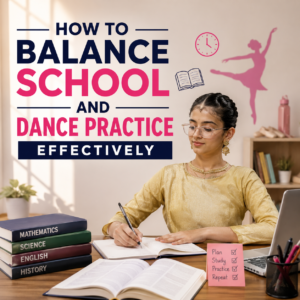
Preparation should build confidence, not add pressure. If you are struggling to fit practice around schoolwork, here’s how to balance school and dance practice without burning out.
How to Gain Confidence in Dance
Confidence comes from several things working together:
Practice + Preparation + Experience + Positive mindset
You cannot build stage confidence simply by telling yourself to be confident. You build it by repeatedly putting yourself in situations where you have to perform. Start with small performances. Accept mistakes. Learn from each one. Celebrate your progress. Over time, the stage that once made you nervous becomes the place where you feel most comfortable expressing yourself.
When Stage Fear Needs Extra Support
For most dancers, nerves settle with practice and repeated stage exposure. Occasionally, though, the anxiety goes further. A student may feel physically unwell before every performance, start avoiding opportunities altogether, or feel distressed for days beforehand.
If that sounds familiar, it is worth speaking to a teacher, a parent or a qualified counsellor. Persistent performance anxiety is a well-recognised issue, and there is no reason for a dancer to manage it alone.
Final Thoughts
Stage fear is not a sign that you lack talent. It is a challenge almost every dancer faces, particularly when they are new to performing in front of an audience.
The key is preparation, regular practice, breathing, a positive mindset and repeated stage exposure. Don’t wait until you feel completely fearless before you perform.
Step onto the stage while you are still nervous. Take a breath. Listen to the music. Trust your training. And dance.
With every performance you learn something new — not only about dance, but about yourself.
Frequently Asked Questions
Why do I feel nervous before performing?
Your brain treats performing in front of an audience as a high-pressure situation. Fear of making mistakes, fear of being judged, or worry about forgetting the choreography all increase that nervousness. It is a normal physical response, not a sign of weak ability.
How can I remove stage fear in dance?
You can reduce stage fear through regular practice, mock performances in front of family or classmates, breathing exercises, visualisation and gradually gaining more stage experience. The aim is to manage nervousness rather than eliminate it completely.
How can I perform confidently on stage?
Know your choreography thoroughly, practise without relying on the mirror, focus on the music rather than the audience, maintain good posture, keep natural expressions and avoid worrying about audience reactions.
How can I gain confidence in dance?
Consistent training and regular performance opportunities are the two most effective ways. Recording your practice, reviewing it honestly and learning from each performance also helps a great deal.
What should I do if I forget my dance steps on stage?
Stay calm and keep moving. Listen to the music and rejoin the choreography at the next familiar point. Avoid stopping suddenly or showing panic — most of the audience will not notice.
Can children overcome stage fear?
Yes. With encouragement, regular practice, supportive teaching and gradual exposure to performances, children usually become much more comfortable on stage within a few performances.
Learn, Practise and Perform with Aarambh Music & Dance Academy, Rohini
At Aarambh Music & Dance Academy in Rohini Sector 8, Delhi, dance training goes well beyond learning steps. Students of Bharatanatyam, Kathak, Semi-Classical and Western dance build technique, rhythm, expression and discipline — and, just as importantly, the confidence to perform.
Small batches mean every student gets individual attention. Regular stage opportunities and practical exam preparation help dancers become comfortable performing in front of an audience, step by step, rather than all at once.
If you or your child wants to begin learning dance — or simply wants to feel more confident on stage — structured guidance makes the journey easier and far more enjoyable.
Admissions are open. Book a free demo class or call +91-98111 40614 · 011-45019629